Introduction
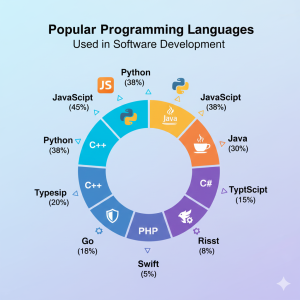
Programming languages form the backbone of software development. Every application, website, or system relies on one or more programming languages to function. Choosing the right programming language can significantly impact performance, scalability, security, and development speed.
With rapid advancements in technology, programming languages continue to evolve to meet modern software development demands. In 2025, developers must consider factors such as cross-platform compatibility, cloud support, performance, and community adoption when selecting a language.
In this blog, we explore the top programming languages used in software development, their strengths, use cases, and how to choose the best language for your project or career.
Why Programming Languages Matter in Software Development
Programming languages define how developers communicate with machines. Each language has unique syntax, paradigms, and capabilities that make it suitable for specific tasks.
Key benefits of choosing the right language include:
-
Faster development cycles
-
Better maintainability
-
Improved performance
-
Enhanced security
1. Python
Overview
Python is one of the most popular programming languages due to its simplicity and versatility.
Key Features
-
Easy-to-read syntax
-
Extensive libraries and frameworks
-
Strong community support
Use Cases
-
Web development
-
Data science
-
Machine learning
-
Automation
Python is ideal for beginners and professionals alike.
2. JavaScript
Overview
JavaScript is the core language of web development and plays a vital role in both frontend and backend development.
Key Features
-
Event-driven programming
-
Cross-platform support
-
Rich ecosystem
Use Cases
-
Web applications
-
Mobile app development
-
Server-side development
JavaScript enables full stack development using a single language.
3. Java
Overview
Java remains a dominant language in enterprise software development.
Key Features
-
Platform independence
-
Strong security
-
Scalability
Use Cases
-
Enterprise applications
-
Android development
-
Backend systems
Java is widely used in large-scale systems.
4. C++
Overview
C++ is known for high performance and system-level programming.
Key Features
-
Low-level memory control
-
High efficiency
-
Object-oriented support
Use Cases
-
Game development
-
Operating systems
-
Embedded systems
C++ is ideal for performance-critical applications.
5. C#
Overview
C# is a modern language developed by Microsoft, commonly used with the .NET framework.
Key Features
-
Strong typing
-
Rich libraries
-
Cross-platform with .NET Core
Use Cases
-
Desktop applications
-
Web APIs
-
Game development
6. Go (Golang)
Overview
Go is designed for simplicity and scalability.
Key Features
-
Fast compilation
-
Built-in concurrency
-
Cloud-native support
Use Cases
-
Microservices
-
Cloud applications
-
Networking tools
How to Choose the Right Programming Language
Consider these factors:
-
Project requirements
-
Performance needs
-
Community and ecosystem
-
Learning curve
Programming Languages and Career Growth
Learning in-demand programming languages increases job opportunities and earning potential.
Conclusion
Programming languages are essential to software development. Each language serves different purposes, and choosing the right one ensures successful project outcomes. Staying updated with modern languages prepares developers for future challenges.
Frequently Asked Questions (FAQs)
1. Which programming language is best for beginners?
Python and JavaScript are beginner-friendly.
2. Can one programming language do everything?
No, different languages excel at different tasks.
3. Is Java still relevant in 2025?
Yes, Java remains widely used in enterprise systems.
4. Which language is best for web development?
JavaScript is essential for web development.
5. Should I learn multiple languages?
Yes, learning multiple languages enhances versatility.
6. How often should developers update their skills?
Continuously, as technology evolves rapidly.
Connect with us: https://www.facebook.com/profile.php?id=61555452386126