The Ultimate Guide to AI in Healthcare Software Development: Engineering the Future of Medicine
The intersection of medicine and technology is no longer about digitized paperwork or basic electronic health records (EHRs). We have officially entered the era of intelligent software. Today, AI in healthcare software development is reshaping how doctors diagnose diseases, how hospitals manage chaotic workflows, and how pharmaceutical giants discover life-saving drugs.
But building software for the healthcare sector isn’t like building a standard consumer app. It requires an intricate dance between cutting-edge machine learning model architectures, strict data privacy regulations, and an absolute zero-tolerance policy for critical errors.
Whether you are a product manager, a software engineer, or a healthcare innovator, this definitive guide will walk you through everything you need to know about developing AI-driven healthcare solutions in a human-centric way.
1. Why AI is a Necessity (Not a Luxury) in Modern Healthcare
The global healthcare system is facing a quiet crisis: exploding patient volumes, skyrocketing costs, and unprecedented levels of clinician burnout. Doctors spend hours staring at screens typing clinical notes instead of looking at their patients.
This is where artificial intelligence steps in—not to replace the human touch, but to supercharge it. By integrating AI into healthcare software, we can offload cognitive friction from medical staff, allowing them to focus on what they do best: healing.
The Macro Benefits of Intelligent Medical Software
-
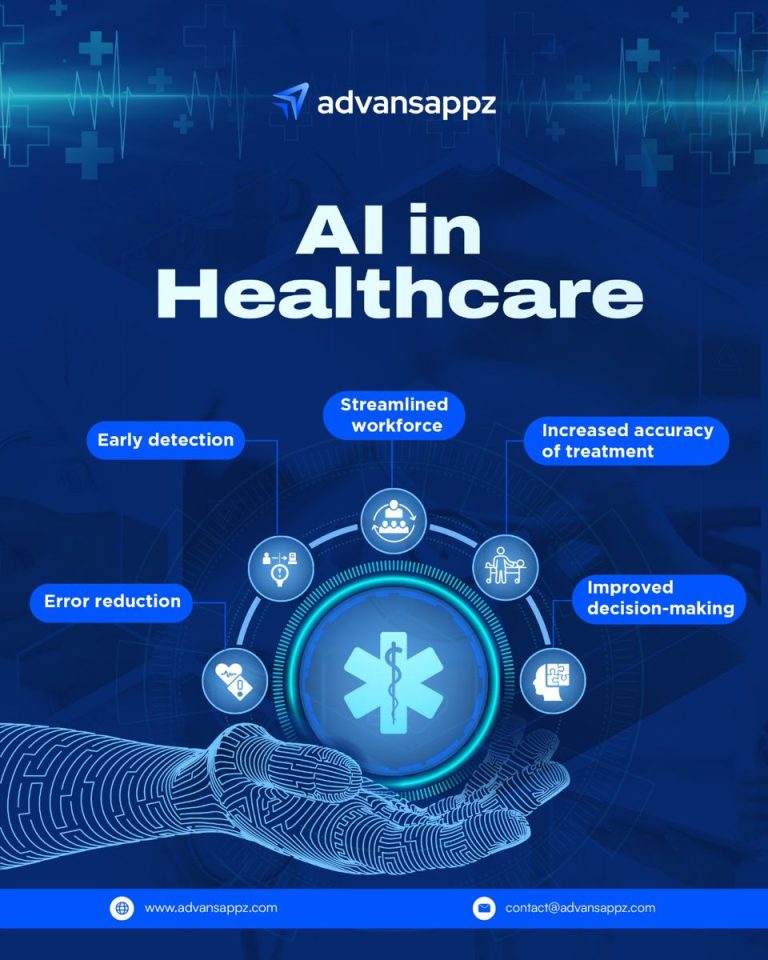
Hyper-Speed Diagnostics: Processing massive datasets (like MRI scans or genomic sequences) in seconds rather than days.
-
Erasing Administrative Friction: Automated charting, smart scheduling, and instant medical billing triaging.
-
Proactive Care: Shifting medicine from reactive (treating the sick) to predictive (preventing the illness before symptoms manifest).
2. Core Use Cases of AI in Healthcare Software Development
To build a valuable product, you must first understand exactly where machine learning can solve real-world clinical pain points. Let’s break down the primary domains where AI software is driving the highest return on investment (ROI).
A. Medical Imaging and Computer Vision
Radiology, pathology, and dermatology rely heavily on visual analysis. Computer vision models can analyze images with pixel-level accuracy to flag anomalies that might escape the tired human eye at the end of a 14-hour shift.
-
Tumor Detection: Deep learning algorithms (specifically Convolutional Neural Networks, or CNNs) scan CT and MRI images to identify early-stage oncological growths.
-
Cardiovascular Risks: Software analyzing echocardiograms can calculate ejection fractions and detect subtle arterial blockages automatically.
B. Generative AI and Natural Language Processing (NLP) in Clinical Workflows
Generative AI has completely transformed healthcare software development. Clinical documentation is the primary driver of doctor burnout; LLMs (Large Language Models) are solving this problem directly.
-
Ambient Clinical Documentation: AI software listens to a doctor-patient conversation (with consent), filters out the small talk, and automatically drafts a structured clinical note (SOAP note) directly into the EHR system.
-
Medical Text Summarization: Synthesizing hundreds of pages of a patient’s historical medical records into a concise, actionable one-page summary for emergency room clinicians.
C. Predictive Analytics for Patient Care
By running historical patient data through predictive models, software can alert care teams about critical events before they occur.
-
Sepsis Prediction: Sepsis is a leading cause of hospital deaths. AI algorithms constantly monitor live vitals (heart rate, blood pressure, lab results) to give nurses a 6-hour head start on a potential septic shock.
-
Readmission Risk Scoring: Identifying which discharged patients are at a high risk of returning within 30 days, prompting proactive outpatient follow-ups.
D. AI-Driven Drug Discovery and Genomics
Developing a new pharmaceutical drug traditionally takes over a decade and costs billions of dollars. AI software cuts this timeline exponentially.
-
Molecular Simulation: Machine learning models predict how different chemical compounds will interact with target proteins, narrowing down millions of drug candidates to a handful of viable options in weeks.
-
Genomic Mapping: Identifying specific genetic mutations to design highly tailored, personalized cancer therapies.
3. The Architecture of a Healthcare AI Application
Building an AI healthcare application requires a robust, highly secure, and modular software architecture. Because medical data is highly dynamic, your infrastructure must support both continuous training and split-second real-time inference.
The Standard Technical Stack for Healthcare AI
A typical enterprise-grade AI medical application relies on a multi-layered ecosystem:
| Layer | Recommended Technologies / Frameworks | Purpose |
| Data Ingestion | Kafka, AWS Kinesis, HL7/FHIR APIs | Capturing real-time streams of patient data and vitals safely. |
| Data Processing | Apache Spark, Pandas, DICOM parsers | Cleaning medical images, normalizing electronic health notes. |
| AI/ML Engine | PyTorch, TensorFlow, Hugging Face Transformers | Building, training, and deploying deep learning and LLM models. |
| Database & Storage | PostgreSQL, MongoDB, AWS S3 (encrypted) | Storing relational patient data and unstructured medical imagery. |
| Interoperability | Hapi FHIR, Smile CDR | Ensuring the software seamlessly speaks to hospital legacy systems. |
4. Step-by-Step Development Lifecycle for Medical AI Software
Developing AI software for a hospital or clinic requires a systematic, rigorous approach. Unlike standard SaaS applications, you cannot simply “move fast and break things” when human health is on the line.
Step 1: Solving the Medical Data Conundrum
AI models are only as good as the data they eat. In healthcare, getting clean data is incredibly difficult due to strict privacy laws.
-
Data Anonymization: You must meticulously strip away all Personally Identifiable Information (PII) and Protected Health Information (PHI) before feeding data to your models.
-
Labeling and Annotation: For clinical tasks, you cannot use cheap crowdsourced labeling. You need licensed radiologists, pathologists, and cardiologists to annotate your training data, which requires considerable time and investment.
Step 2: Model Selection and Training
Decide whether to build custom models from scratch or fine-tune existing foundation models.
-
For niche imaging tasks, building custom, lightweight CNNs is often preferred.
-
For clinical text automation, fine-tuning medical-specific open-source LLMs (like Med-PaLM or specialized BioBERT variants) yields excellent results without requiring millions of dollars in compute costs.
Step 3: Seamless Integration (The Interoperability Challenge)
Your brilliant AI model will fail to gain adoption if it requires doctors to open a separate tab or log into a standalone dashboard. It must live natively inside their existing ecosystem.
-
FHIR Protocols: Use Fast Healthcare Interoperability Resources (FHIR) and HL7 standards to pipe your model’s outputs directly into industry-standard EHR platforms like Epic, Cerner, or Allscripts.
Step 4: UI/UX for Clinicians
Doctors are constantly fatigued. If your software’s user interface is cluttered or confusing, it will be rejected immediately.
-
Explainable AI (XAI): Don’t just give a prediction (e.g., “92% risk of malignancy”). Your UI must highlight why the model thinks so (e.g., heat-mapping the specific area on the X-ray or citing the exact lab value used).
-
Actionable Alerts: Design clear, non-intrusive notification frameworks to prevent “alert fatigue” among nursing staff.
5. Overcoming Regulatory, Security, and Compliance Hurdles
Compliance isn’t a feature you tack on right before launch; it must be baked directly into your system’s core architecture from day one.
A. Global Regulatory Landscapes
Depending on where your software will be deployed, you must adhere to strict regulatory compliance frameworks:
-
HIPAA (USA): Requires end-to-end data encryption (both at rest and in transit), strict access controls, and comprehensive audit logs detailing exactly who viewed patient data.
-
GDPR (Europe): Mandates explicit patient consent, data minimization, and the absolute “right to be forgotten.”
-
FDA Clearances: If your AI software actively diagnoses diseases or guides treatment decisions, it is classified as SaMD (Software as a Medical Device). You will need to clear rigorous FDA 510(k) or De Novo regulatory pathways before commercialization.
B. Mitigating AI Bias and Ensuring Equity
AI models are notorious for inheriting the biases of their training data. If a dermatology AI is trained exclusively on light skin tones, its accuracy drops drastically on darker skin tones.
-
Diverse Datasets: Actively source clinical training data across diverse demographics, age groups, and geographic regions.
-
Continuous Auditing: Run routine fairness audits on your production models to catch statistical drift or emerging demographic bias early.
6. The Future Horizon: What’s Next for Healthcare Software?
The landscape of AI in healthcare software development is shifting rapidly. As we look toward the future, several massive trends are poised to define the next generation of medical software:
-
Multimodal AI Ecosystems: Future software won’t just look at text or images in isolation. It will synthesize a patient’s genetic profile, their historical EHR notes, and their live wearable data simultaneously to create a truly holistic 360-degree health overview.
-
Edge AI for Wearables: Running optimized, ultra-lightweight AI models directly on consumer smartwatches and continuous glucose monitors to detect cardiac arrhythmias or diabetic spikes locally without requiring a persistent cloud connection.
-
AI-Driven Automated Clinical Trials: Software that intelligently scans millions of digital patient profiles to instantly match ideal candidates with experimental clinical trials, accelerating medical breakthroughs from years to days.
7. Strategic Checklist for Product Leaders & Engineering Teams
Are you getting ready to kick off your own healthcare AI software initiative? Use this checklist to keep your development team aligned and on track:
-
[ ] Identify the True Clinical Bottleneck: Are you actually solving an immediate, daily pain point for providers, or are you building technology for technology’s sake?
-
[ ] Establish an End-to-End Compliance Framework: Ensure HIPAA/GDPR data pipelines and robust audit trails are fully mapped out before writing code.
-
[ ] Form a Clinical Advisory Board: Put practicing physicians, nurses, and medical compliance experts in the room with your software developers from day one.
-
[ ] Design with Interoperability in Mind: Verify that your system architecture natively relies on modern FHIR/HL7 data pipelines for seamless hospital EHR integration.
-
[ ] Prioritize Explainable AI (XAI): Ensure your user interface shows clear context alongside model predictions to build genuine clinical trust and user adoption.
Conclusion: Driving Human-Centric Medical Innovation
Building software embedded with AI for the medical industry is an immense responsibility. It requires deep technical expertise, unwavering ethical standards, and a thorough understanding of clinical environments.
By focusing on workflows that actively reduce clinician burnout, maintaining ironclad data security, and ensuring your models remain completely transparent and explainable, your development team can build software that doesn’t just innovate—it saves lives. The future of medicine is being written in code right now. Are you ready to build it?