The Ultimate Guide to Generative Engine Optimization: How to Rank in Google AI Overviews
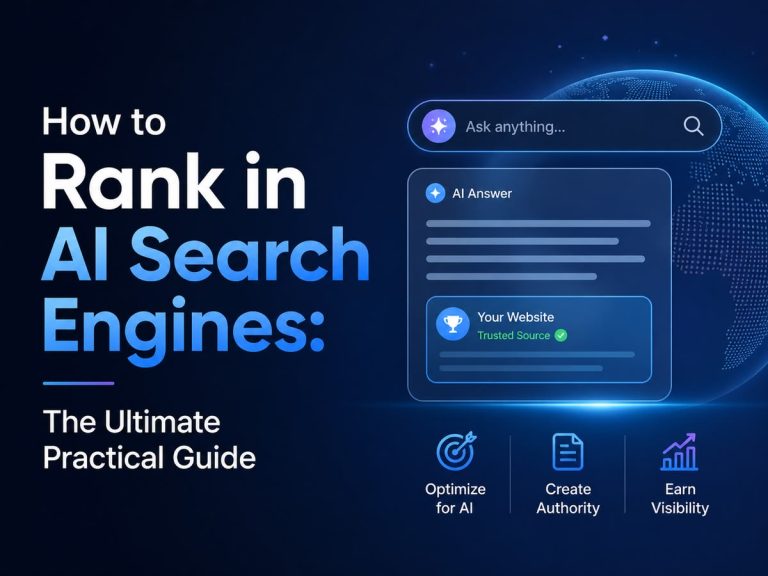
The rules of Search Engine Optimization have fundamentally transformed. We are no longer living in a pure “rank-and-click” ecosystem. With the global rollout and maturity of Google’s AI Overviews (formerly known as SGE), the primary objective of modern SEO has pivoted from simply ranking a URL on page one to becoming the undisputed“source of truth” extracted by Large Language Models (LLMs).
When a user executes a complex or long-tail search query, Google does not merely list links; it reads, processes, extracts facts, and synthesizes a comprehensive response directly at the top of the Search Engine Results Page (SERP).
If your content isn’t built to feed this synthesis engine, your organic visibility will plummet. This guide provides a comprehensive blueprint on how to rank in Google AI Overviews and secure your brand’s share of voice in an AI-first digital world.
1. Deconstructing Google AI Overviews: How the Synthesis Engine Works
To optimize for AI Overviews, you must first understand how Google’s retrieval and generation pipeline functions. Unlike traditional algorithmic indexing, which relies heavily on keyword matching and PageRank, generative search works through a multi-layered framework often called Generative Engine Optimization (GEO).
[User Query] ➔ [Retrieval Layer: Top Organic Pages] ➔ [Extraction Layer: Fact & Entity Isolation] ➔ [Synthesis Layer: LLM Summarization] ➔ [AI Overview + Citations]The system breaks down into four essential operations:
-
Layer 1: Retrieval Readiness: Google pulls a pool of high-quality pages from its index based on foundational trust signals, indexing health, and initial query matching. If you aren’t in the top organic tier, you won’t be considered for the AI layer.
-
Layer 2: Extraction Clarity: The AI parsing bots scan the page text. They look for explicit data nodes, entities, and plain-language syntax that can be cleanly separated from the surrounding text.
-
Layer 3: Synthesis Compatibility: The generative model determines whether your text can be smoothly merged with other authoritative sources to form a cohesive, multi-perspective answer.
-
Layer 4: Citation Signaling: Google applies its Diversity Ranking and accuracy filters, checking your content against verified knowledge networks. If your data is distinct and verified, your site receives the coveted link card or inline citation citation.
2. Shift Your Mindset: Keywords vs. Entities
The most profound shift required for success is moving away from keyword frequency and towardEntity Resolution and Knowledge Modeling.
AI models do not look at words as isolated strings of text. They view them asentities (people, places, concepts, technologies, organizations) and map therelationships between them.
| Metric / Attribute | Traditional SEO Era | AI Overview (GEO) Era |
| Primary Target | Latent Semantic Keywords | Named Entities & Concepts |
| Value Indicator | Backlink Quantity & Anchor Texts | Information Gain & Unique Data |
| Textual Style | Comprehensive, Long-form Prose | Modular, Atomic Information Units |
| Visibility KPI | Position 1–10 Blue Links | Citation Share of Model & Impressions |
Instead of stuffing variants of “how to rank in Google AI Overviews” throughout your page, you must structure your content to explicitly define the concepts surrounding it, such as Generative Engine Optimization, Retrieval-Augmented Generation (RAG), Structured Data, and E-E-A-T.
3. Structural Architecture: The “Atomic Answer” Blueprint
AI engines prioritize content that is highly scannable and modular. To capture the AI summary block, you should adopt theAtomic Answer Blueprint. This means placing a highly condensed, hyper-focused “definition block” directly beneath your primary headings.
Guidelines for Crafting an Atomic Passage:
-
The 50-Word Rule: Keep your opening statement between 40 to 60 words.
-
The Direct Copula Structure: Use declarative, objective syntax (e.g., “Generative Engine Optimization is an SEO practice that…” instead of “When looking at the future of search, we see that…”).
-
Eliminate Fluff: Strip out introductory filler, rhetorical questions, and marketing hyperbole.
-
Stand-Alone Viability: Ensure the passage makes perfect sense if quoted entirely out of context by an LLM.
Example Anatomy of an Optimized Subsection:
What is Generative Engine Optimization (GEO)?
Generative Engine Optimization (GEO) is the process of optimizing web content to be reliably retrieved, extracted, and cited by artificial intelligence search engines and LLM-powered answer boxes. It focuses on clear information architecture, explicit entity definitions, and verifiable trust signals over traditional keyword densities.
4. The 7 Essential Pillars to Rank in AI Overviews
To systematically earn placements within AI summaries, your content development strategy must cover seven core optimization tracks.
Pillar 1: Optimize for Information Gain
Google’s algorithmic filters are designed to penalize commodity content. If your article simply paraphrases Wikipedia or mirrors the top three ranking sites, the synthesis engine has no incentive to cite you. It already has that data.
To score high on Information Gain, you must inject proprietary value into your assets:
-
Incorporate original data matrices, proprietary statistics, or internal survey results.
-
Provide real-world case studies detailing execution steps and exact outcomes.
-
Include expert commentary and quotes from verified industry specialists with verifiable digital identities.
Pillar 2: Format for Discrete Machine Extraction
If an AI model has to struggle to parse your layout, it will move on to a cleaner source. Use programmatic design patterns to present your data layout clearly:
-
Tables for Comparison: Instead of explaining product or strategic differences over four paragraphs, build a structured comparison table using clear markdown or HTML tags.
-
Numbered Procedures: For transactional or procedural “how-to” queries, layout steps chronologically using clean ordered lists.
-
Bulleted Lists for Enumeration: When listing features, tools, or signals, use distinct bulleted formatting to allow the AI to quickly grab the items for summary generation.
Pillar 3: Supercharge Programmatic Schema and Knowledge Graphs
Structured data provides a direct bridge between your text and Google’s internal Knowledge Graph. It removes contextual ambiguity. Ensure your technical deployment leverages detailed JSON-LD injections:
JSON
{ "@context": "https://schema.org", "@type": "TechArticle", "headline": "How to Rank in Google AI Overviews", "author": { "@type": "Person", "name": "Pushkar Pandey", "sameAs": "https://www.linkedin.com/in/yourprofile" }, "publisher": { "@type": "Organization", "name": "TechOTD", "logo": "https://techotd.com/logo.png" }, "about": [ { "@type": "Thing", "name": "Generative Engine Optimization", "sameAs": "https://en.wikipedia.org/wiki/Search_engine_optimization" } ] }Implement FAQPage, HowTo, and Product schemas wherever applicable to clearly signal the boundaries of your factual data blocks.
Pillar 4: Solidify E-E-A-T and Digital Entity Verification
Because generative AI models are prone to hallucinations, Google applies rigorous quality filtering to its source pools. This relies heavily on Experience, Expertise, Authoritativeness, and Trustworthiness (E-E-A-T).
-
Author Credentials: Every informational article must feature an explicit author bio including degrees, industry experience, and direct links to established external social properties (such as LinkedIn via
sameAsattributes). -
Editorial Verification: Explicitly note who reviewed and fact-checked the article data.
-
Reference Anchoring: Do not make unsupported factual statements. Link out directly to primary research, government whitepapers, or academic databases to anchor your claims.
Pillar 5: Deepen Semantic Content Clusters
Topical authority is a massive trust signal for generative engines. A single standalone post on an advanced topic rarely gets pulled into AI Overviews. Instead, build interconnected content hubs:
-
Pillar Page: A comprehensive guide covering the macro topic (e.g., AI Search Marketing).
-
Cluster Content: Highly targeted child pages answering micro queries (e.g., How Schema impacts AI retrieval, Optimizing Core Web Vitals for LLM Crawlers).
-
Contextual Anchor Text: Interlink these pages using descriptive, entity-based anchor texts. Avoid non-descriptive links like “click here” or “read more.”
Pillar 6: Maintain Factual Freshness
AI algorithms heavily prioritize temporal relevance and accurate data points. Outdated statistics are a quick way to be dropped from the citation indexing rotation.
-
Establish a quarterly content audit cycle to replace legacy timestamps and metrics.
-
Update old data points with current industry figures.
-
Re-validate and verify that your outgoing contextual links still lead to live, accurate, and authoritative domains.
Pillar 7: Eliminate Technical Barriers and Render Blocks
Your content cannot be integrated into an AI summary if the rendering bots cannot access it rapidly. Fix technical bottlenecks immediately:
-
Avoid Hidden Content: Keep all crucial answers visible within the main body text. Do not tuck primary definitions inside unrendered accordions, tab components, or lazy-loaded containers.
-
Prioritize Page Loading Speed: Optimize server response times, utilize global CDNs, and use lightweight image formatting (WebP/AVIF) to pass Core Web Vitals tests.
-
Clean DOM Trees: Keep your underlying HTML lean, clean, and semantic to maximize crawl-budget extraction efficiency.
5. Step-by-Step Execution Framework for Content Creators
To operationalize this strategy for your writing or editorial team, implement this standardized workflow for every post you create.
Step 1: Semantic Mapping & Query Analysis
Before writing, run targeted searches for your primary topic. Analyze the current AI Overview layout along with thePeople Also Ask (PAA) accordions. Identify the core sub-questions the AI prioritizes and map them directly into your article’s structural H2 and H3 heading flow.
Step 2: Draft the Content Modules
Draft your article in modular components. Approach each subsection as a standalone answer to a specific sub-query. Place your 50-word atomic definition directly at the top of the section, support it with a data visualization or formatted list, and follow up with deep-dive contextual narrative.
Step 3: Implement Entity Cross-Linking
Review your copy and identify key technical entities. Ensure that terms are standardized throughout the text. Use explicit internal links to direct the reader (and the crawler) to your auxiliary topic nodes to demonstrate complete topical ownership.
Step 4: Validate and Fact-Check
Examine every statistic, figure, and claim within your draft. Match them against trusted primary sources and ensure proper attribution links are embedded directly into your prose.
6. Measuring Success: Tracking AI Visibility KPIs
Traditional rank tracking tools that monitor position 1 through 10 are insufficient for tracking performance in generative search features. To evaluate your GEO performance, monitor these refined indicators:
-
AI Citation Frequency: The percentage of target queries where your domain is actively chosen as an inline source link within the AI box.
-
Share of Model (SoM): Your brand’s total footprint across synthesized informational responses within your industry vertical.
-
Search-to-Synthesis Ratio: Tracking changes in impressions via Google Search Console relative to adjustments made to your scannable text architectures.
-
Micro-Conversion Performance: Monitoring down-funnel metrics like resource downloads and email opt-ins from high-intent users navigating via AI Overview citations.
Conclusion
Ranking in Google AI Overviews requires a paradigm shift from traditional keyword-centric optimization to an approach centered onclarity, trust, and structural visibility. Search engines have evolved from traffic directories into synthesis platforms that extract information to create answers.
To stay visible, you must design your content to serve as the high-quality, verified source material these machine-learning models rely on. By implementing clean content architecture, prioritizing entity density, providing unique value, and supporting your claims with rigorous E-E-A-T signals, you can ensure your brand remains a trusted source in this new age of search.