Introduction
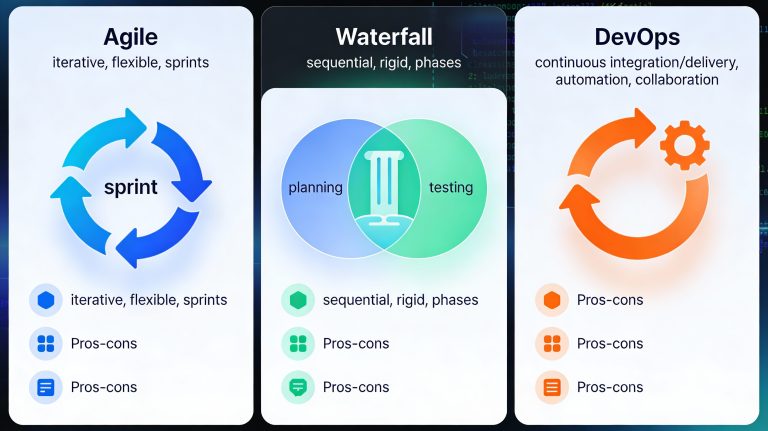
Choosing the right software development methodology is one of the most important decisions for any development project. The methodology you select determines how your team plans, builds, tests, and delivers software. Among the many approaches available today, Agile, Waterfall, and DevOps are the most widely used and debated.
Each methodology has its strengths, weaknesses, and ideal use cases. While some teams prefer the structure of Waterfall, others thrive on the flexibility of Agile or the speed of DevOps. Understanding these models helps organizations align their development strategy with business goals.
In this blog, we will compare Agile vs Waterfall vs DevOps, explore how each model works, and help you choose the right approach for your software development needs.
What Are Software Development Methodologies?
Software development methodologies are structured frameworks that define how software projects are planned, executed, and delivered. They provide guidelines for collaboration, workflow, documentation, and quality assurance.
The right methodology improves efficiency, reduces risk, and ensures consistent delivery of high-quality software.
Waterfall Methodology
Overview
The Waterfall model is one of the earliest software development methodologies. It follows a linear and sequential approach, where each phase must be completed before moving to the next.
Phases of Waterfall
-
Requirement analysis
-
System design
-
Development
-
Testing
-
Deployment
-
Maintenance
Advantages of Waterfall
-
Clear structure and documentation
-
Easy to manage and understand
-
Ideal for projects with fixed requirements
Disadvantages of Waterfall
-
Limited flexibility
-
Changes are costly
-
Late testing increases risk
Best Use Cases
-
Government projects
-
Regulatory-compliant systems
-
Projects with well-defined requirements
Agile Software Development
Overview
Agile is an iterative and incremental approach focused on flexibility, collaboration, and customer feedback. Instead of delivering the entire product at once, Agile teams work in short cycles called iterations or sprints.
Key Principles of Agile
-
Customer collaboration over contracts
-
Responding to change over following a plan
-
Continuous delivery of working software
Popular Agile Frameworks
-
Scrum
-
Kanban
-
Extreme Programming (XP)
Advantages of Agile
-
Faster delivery
-
High adaptability to change
-
Continuous user feedback
-
Improved team collaboration
Disadvantages of Agile
-
Less predictability
-
Requires experienced teams
-
Documentation may be limited
Best Use Cases
-
Startups
-
Mobile and web applications
-
Projects with evolving requirements
DevOps Methodology
Overview
DevOps is a cultural and technical approach that combines development and operations to improve collaboration, automation, and deployment speed. It focuses on continuous integration, continuous delivery, and continuous monitoring.
Key DevOps Practices
-
CI/CD pipelines
-
Infrastructure as code
-
Automated testing
-
Continuous monitoring
Advantages of DevOps
-
Faster release cycles
-
Improved software quality
-
Better system reliability
-
Reduced deployment failures
Disadvantages of DevOps
-
Requires cultural change
-
Initial setup complexity
-
Tooling and automation costs
Best Use Cases
-
Large-scale systems
-
Cloud-native applications
-
High-availability platforms
Agile vs Waterfall vs DevOps: Key Differences
| Feature | Waterfall | Agile | DevOps |
|---|---|---|---|
| Flexibility | Low | High | Very High |
| Delivery | One-time | Incremental | Continuous |
| Customer Feedback | Late | Continuous | Continuous |
| Automation | Minimal | Moderate | Extensive |
| Speed | Slow | Fast | Very Fast |
How to Choose the Right Methodology
Consider the following factors:
1. Project Requirements
Stable requirements favor Waterfall, while changing requirements favor Agile or DevOps.
2. Team Experience
Agile and DevOps require skilled, self-managed teams.
3. Time-to-Market
DevOps and Agile enable faster releases.
4. Compliance and Documentation
Waterfall suits heavily regulated industries.
Modern Hybrid Approaches
Many organizations adopt hybrid models, such as Agile-DevOps or Waterfall-Agile hybrids, to balance structure and flexibility. These approaches leverage the strengths of multiple methodologies.
Conclusion
There is no one-size-fits-all software development methodology. Waterfall offers structure, Agile provides flexibility, and DevOps delivers speed and automation. The right choice depends on your project goals, team capabilities, and business needs.
By understanding Agile, Waterfall, and DevOps, organizations can build software that is reliable, scalable, and aligned with modern development demands.
Frequently Asked Questions (FAQs)
1. Which software development methodology is best?
The best methodology depends on project requirements, team experience, and delivery timelines.
2. Is Agile better than Waterfall?
Agile is better for flexible projects, while Waterfall works well for fixed-scope projects.
3. Can Agile and DevOps be used together?
Yes, Agile and DevOps complement each other and are commonly used together.
4. Is DevOps only for large companies?
No, DevOps can benefit organizations of all sizes.
5. Does Waterfall still exist today?
Yes, Waterfall is still used in regulated and documentation-heavy industries.
6. Can one project use multiple methodologies?
Yes, hybrid approaches are common in modern software development.
Connect With Us: https://www.facebook.com/profile.php?id=61555452386126