The Future of Search After AI: Navigating the Era of Generative Discovery
For nearly three decades, the foundational mechanics of the internet relied on a simple, predictable contract: a user typed a sequence of keywords into a blank text box, an engine matched those strings against an index of web pages, and the user clicked a blue link to find their answer. This “rank-and-click” paradigm built empires, funded global digital media economies, and formed the bedrock of Search Engine Optimization (SEO).
That contract has officially expired.
We are living through the most volatile paradigm shift in the history of digital information architecture. The emergence of advanced Large Language Models (LLMs), conversational engines, and multi-modal assistants has transformed search engines from mere finding tools into synthesis tools.
Instead of guiding users to a destination where an answer lives, search engines now read the destinations, extract the data, and build the answer themselves. Understanding the future of search after AI requires looking beyond simple keyword lists to understand Generative Engine Optimization (GEO), AI-native user behaviors, and the tactical steps required to keep your brand visible in a synthesized digital world.
1. The Anatomy of Modern AI Search Engines
To understand where search is going, we must first look at how the dominant players are evolving their interfaces to merge traditional information retrieval with generative synthesis.
[User Dynamic Intent] │ ▼ [Multi-Modal Vector Analysis] ──► [Real-Time Context Tuning] │ ▼ [Retrieval-Augmented Generation (RAG)] ──► [Vector DB & Core Index] │ ▼ [Synthesized Output Layer] ──► [Conversational Interface + Deep Citations]Google AI Overviews (formerly SGE)
Google’s approach does not entirely discard the traditional web index; instead, it superimposes a generative summary layer above it. Using a sophisticated pipeline rooted in Retrieval-Augmented Generation (RAG), Google pulls a localized cluster of highly authoritative pages, processes their semantic contents in real-time, and generates an objective answer complete with dynamic link cards and inline citations.
OpenAI Search & Conversational Disruptors
Alternative models strip away the remnants of legacy SERPs entirely. They favor a natural, fluid conversational interface. Rather than treating each search as an isolated event, these engines retain memory, understand deep pronouns, and allow users to iteratively narrow down a complex task (e.g., “Find a hotel in Tokyo, narrow it down to options with gym access, and build a three-day itinerary around them”).
Perplexity AI and the Answer Engine Revolution
Perplexity pioneered the concept of the “Answer Engine.” It treats the web as a live vector database, summarizing diverse viewpoints and providing numbered citations for every factual claim. This setup shifts the user’s focus from evaluating website designs to evaluating the factual integrity of the synthesized information block.
2. From Keywords to Entities: The Semantic Shift
In the pre-AI era, search engines were largely deterministic systems matching keywords. If your page contained the phrase “best enterprise data security software” a specific number of times alongside strong backlink signals, you ranked.
In the post-AI ecosystem, search engines operate via vector embeddings and entity graphs.
-
Vector Spaces: Mathematical representations where words, sentences, and entire concepts are plotted as coordinates based on their semantic proximity.
-
Intent Resolution: AI engines understand the hidden intent behind a phrase, even if the user lacks the technical vocabulary to express it perfectly.
-
Entity Relationships: The engine looks at your brand as a node within a massive knowledge network, assessing how it connects to defined industries, founders, products, and competitor nodes.
| Attribute / Metric | Traditional Search Era | Post-AI Search Era |
| Interface Style | Static Page Links | Dynamic Synthesized Text & Media |
| Optimization Focus | Latent Semantic Indexing (LSI) | Entity Realism & Information Gain |
| User Interaction | Query ➔ Fragmented Clicks | Dialogue ➔ Final Resolution |
| Primary Value Metric | Raw Organic Traffic / CTR | Share of Model (SoM) & Citations |
3. The Death of Commodity Content and the Rise of Information Gain
For years, the standard playbook for content marketing was to look at what already ranked on page one, combine the points into a longer article, and optimize the metadata. AI search engines have made this strategy completely obsolete.
Because LLMs already possess a compressed model of all public information, they don’t need another blog post that restates standard industry definitions. If your content reads like a paraphrase of Wikipedia, the AI will absorb it into its training or retrieval data but will have zero incentive to link out to you.
The new currency of digital visibility is Information Gain.
Information Gain = Your Unique Insights - Publicly Available Training DataTo achieve high information gain scores, content must feature:
-
First-Party Data Matrices: Proprietary benchmarks, survey metrics, or internal operational statistics.
-
Deep Case Studies: Verifiable narratives detailing an exact issue, the step-by-step execution taken, and the quantified results.
-
Counter-Intuitive Frameworks: Expert perspectives that challenge common industry assumptions with logical, well-reasoned evidence.
4. The 6 Strategic Pillars of Generative Engine Optimization (GEO)
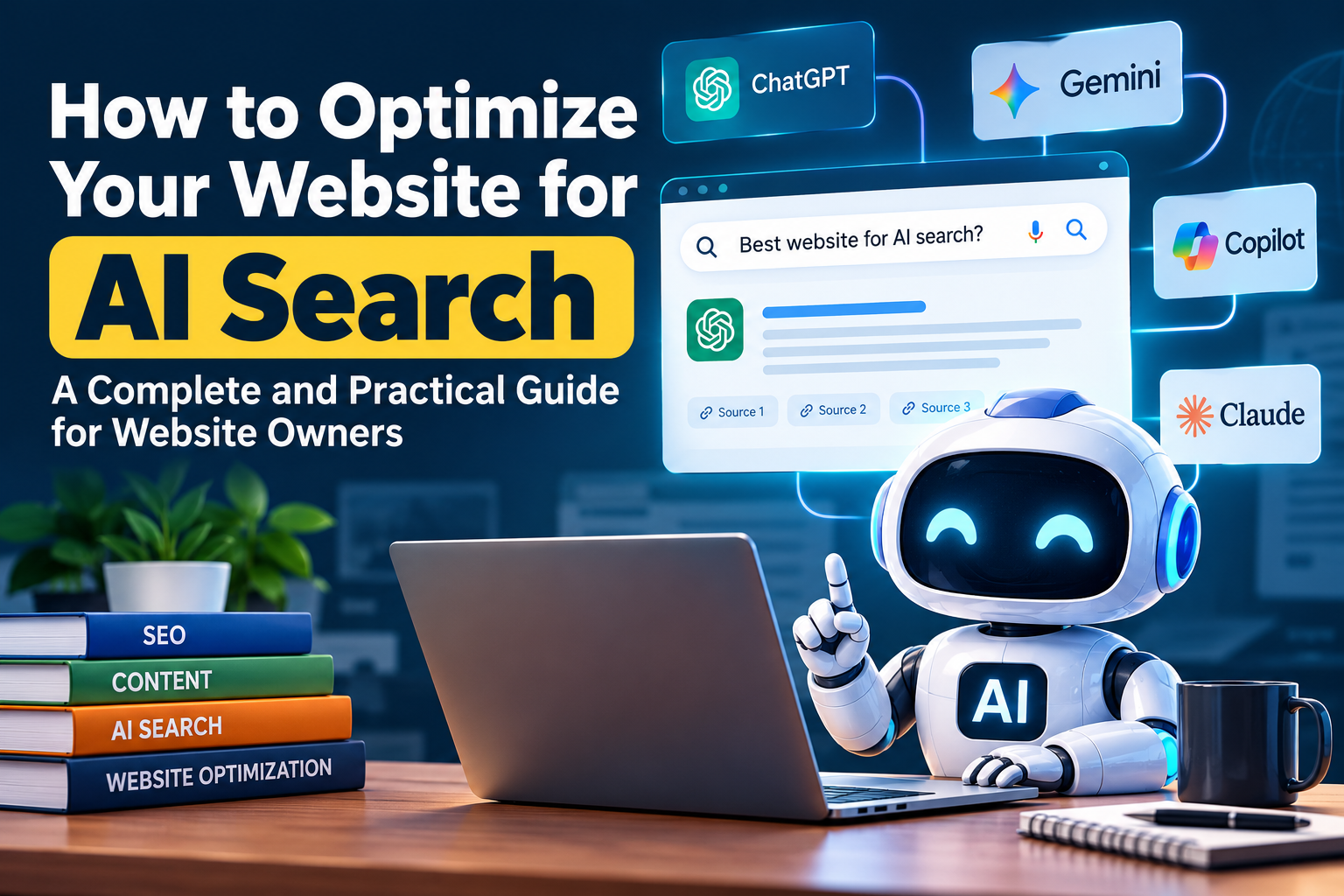
To adapt to the future of search, digital strategies must pivot from classic SEO to Generative Engine Optimization (GEO). Here are the six pillars required to make your digital properties highly indexable for AI search bots.
Pillar 1: The “Atomic Answer” Architecture
AI agents search for information blocks that can be easily extracted and integrated into summaries. To optimize for this, build your pages using an atomic layout:
-
The Definition Anchor: Directly under an H2 or H3 heading, write a 40-to-60-word declarative sentence defining the concept clearly. Avoid preamble or filler text.
-
The Structural Breakdown: Immediately follow that definition with a bulleted list, an ordered sequence, or an HTML data table to make the information easy for machines to read.
-
The Explanatory Context: Follow the structured data block with your deep-dive narrative, analysis, and supporting case examples.
Pillar 2: Radical E-E-A-T and Digital Identity Mapping
Because AI engines risk spreading hallucinations, their retrieval layers use strict quality filtering based on Experience, Expertise, Authoritativeness, and Trustworthiness (E-E-A-T).
-
Author Identity Resolution: Every piece of informational content must be tied to a real person with a verifiable digital footprint. Use explicit schema to connect your author profiles to their external social links (like LinkedIn).
-
Transparent Citations: If you state a factual claim, cite your sources. Link out directly to authoritative whitepapers, academic studies, or official documentation.
-
Brand Asymmetry: Build offline brand authority through public speaking, PR, and industry recognition. The AI reads these offline mentions to calculate your brand’s overall trust score.
Pillar 3: Advanced JSON-LD Schema Integration
Schema markup is no longer an optional technical add-on; it serves as a direct roadmap for AI crawlers trying to parse your content without running into semantic ambiguity.
{ "@context": "https://schema.org", "@type": "TechArticle", "headline": "The Future of Search After AI", "author": { "@type": "Person", "name": "Pushkar Pandey", "sameAs": "https://www.linkedin.com/in/yourprofile" }, "about": [ { "@type": "Thing", "name": "Generative Engine Optimization", "sameAs": "https://en.wikipedia.org/wiki/Search_engine_optimization" } ] }Deploy specialized schema collections—such as ProductModel, Course, FAQPage, and HowTo—across your entire site map to minimize interpretation errors for search engines.
Pillar 4: Optimizing for Voice and Multi-Modal Inputs
The future of search goes far beyond typing on a keyboard. With smart earbuds, phone assistants, and smart glasses, searches are increasingly spoken or triggered by capturing an image.
-
Conversational Long-Tails: Optimize content for how people actually speak. Target natural question frameworks like “Why is my server lagging after the latest patch?” rather than short phrases like “server lag patch”.
-
Visual Information Context: Ensure all images, charts, and technical diagrams feature highly descriptive alt-attributes and surrounding text blocks so visual search engines can fully understand them.
Pillar 5: Deep Topical Clusters Over Isolated Pages
AI engines look at the holistic authority of a domain before trust-indexing its answers. If you write an isolated, excellent article on a topic but your surrounding site lacks related content, you likely won’t get cited. Build dense content ecosystems using a clear hub-and-spoke model, linking child articles back to a core pillar resource using descriptive, entity-based anchor text.
Pillar 6: Technical Efficiency and DOM Cleanliness
If an AI bot hits a rendering wall, a slow server response, or heavy, messy code blocks, it will drop that URL from its real-time retrieval cycle. Streamline your technical foundation by cleaning up your underlying HTML code, optimizing page speed, and keeping primary informational answers fully visible right in the main text body rather than hiding them behind tabs or drop-down accordions.
5. Re-Defining Your Success Metrics: Metrics That Matter
As blue-link click-through rates decline due to instant answers directly on search pages, relying on traditional organic traffic metrics alone can distort your true marketing performance. You need to adjust your key performance indicators (KPIs) for the AI era:
-
Share of Model (SoM): Tracking how often your brand, product, or perspective is natively integrated into conversational search answers within your industry vertical.
-
Citation Volume and Share: Monitoring the volume of direct, clickable link citations your domain secures across AI overview summary sections.
-
High-Intent Referral Value: Though raw informational traffic may decrease, visitors navigating to your site via deep inline AI citations often show higher conversion intent, making close monitoring of down-funnel conversions vital.
Conclusion
The future of search after AI isn’t an existential threat to content creators or brands; it is an evolution of how information is organized and discovered. The web is moving past a simple directory of links into an interconnected ecosystem of synthesized knowledge.
To thrive in this new landscape, you must adapt your digital properties to feed these generation engines clean, structured, and uniquely valuable information. By shifting your focus toward entity authority, maximizing information gain, and formatting your site for clear machine extraction, you can ensure your brand remains a trusted source of truth in an AI-first world.