Introduction
For decades, the local veterinary clinic looked much the same: a waiting room filled with anxious paws, a wall of paper files, and a stethoscope as the primary tool of the trade. But as we move through 2026, the “white coat” profession is undergoing a digital renaissance. Technology isn’t just making the job faster; it’s fundamentally changing how we understand the silent patients who cannot tell us where it hurts.
From Artificial Intelligence that “reads” X-rays to wearable collars that act as 24/7 nurses, the disruption is real, humanized, and—most importantly—saving lives.
The AI Radiologist: Beyond the Human Eye
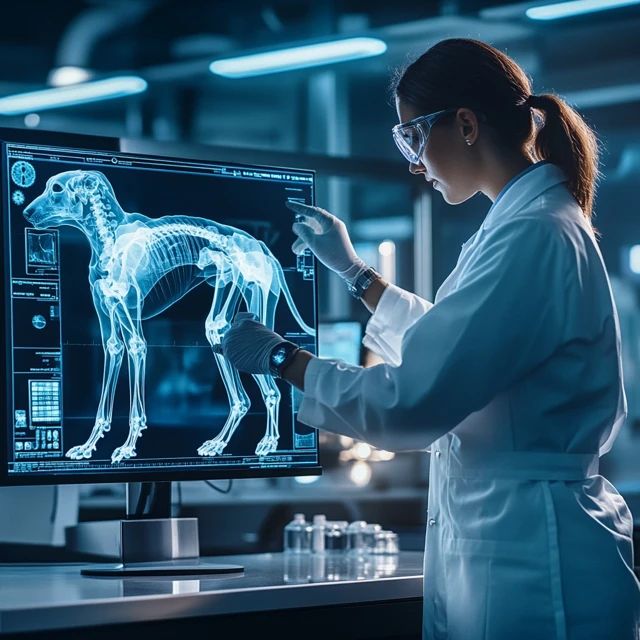
One of the most significant disruptions in modern veterinary medicine is the integration of AI-driven diagnostics. In the past, a vet might wait days for a specialist to review a complex set of radiographs. Today, AI algorithms trained on millions of clinical images can provide a preliminary analysis in under sixty seconds.
These systems aren’t replacing veterinarians; they are providing a powerful “second set of eyes.” By highlighting subtle shadows in a lung lobe or detecting early-stage heart enlargement that might be missed by a tired human eye at the end of a long shift, AI is ensuring that “proactive care” isn’t just a buzzword. It allows the practitioner to discuss treatment options with the owner immediately, while the pet is still on the exam table.
Wearable Tech: Giving a Voice to the Silent Patient
The biggest challenge in veterinary medicine has always been the communication gap. Animals are masters at hiding pain—an evolutionary trait designed to protect them from predators. In 2026, wearable technology has finally closed this gap.
Smart collars and harnesses now monitor much more than just GPS location. They track respiratory rates, sleep quality, scratching frequency, and even “pulse wave velocity” to detect early cardiac distress. When this data is synced with practice management software, it creates a “biometric baseline” for the pet. If a senior dog’s activity level drops by 15% over a week, the clinic’s system can automatically flag this for a follow-up, often catching arthritis or metabolic issues months before the owner notices a limp.
Telemedicine and the “Hybrid Clinic” Model
The pandemic-era pivot to Zoom calls has evolved into a sophisticated “Hybrid Clinic” model. We’ve moved past the clunky video calls of the early 2020s. Today’s veterinary telemedicine platforms integrate directly with home-use diagnostic kits.
Owners can now use smartphone-connected otoscopes to show a vet the inside of an inflamed ear or use AI-powered urine analysis strips that send results directly to the clinic’s database. This disruption saves the “stress-sensitive” pets—like cats who loathe the carrier—from unnecessary travel, while allowing veterinarians to reserve their physical exam rooms for surgical cases and emergencies. It’s a win-win for clinic efficiency and animal welfare.
Revolutionizing Practice Management: The Paperless Heart
Behind the scenes, the “brain” of the clinic—the Practice Management Software (PMS)—has seen the most drastic overhaul. Gone are the days of clunky, on-premise servers. The 2026 veterinary practice is cloud-native and automated.
Automated Workflow and Client Communication
Modern PMS platforms now handle the “invisible work” that used to burn out veterinary staff. Automated systems handle appointment reminders, post-operative check-in texts, and even laboratory result deliveries. When a blood panel is completed by the lab, the software can automatically draft a summary for the vet to approve and send to the owner’s app instantly. This reduces the “phone tag” that has historically plagued the industry.
Inventory Intelligence
Inventory is often the largest expense for a vet practice. Disruptive technology now uses predictive analytics to manage pharmacy stocks. By analyzing local disease trends (like a spike in heartworm cases in a specific zip code), the software can automatically order the necessary medications before the clinic runs out, ensuring that life-saving treatments are always on the shelf.
3D Printing and Personalized Surgery
We are entering an era where “one size fits all” no longer applies to surgery. 3D printing technology is being used to create patient-specific surgical guides and implants. If a dog has a complex bone fracture or a tumor, surgeons can now print a 3D model of that specific animal’s bone structure to practice the surgery before the first incision is made.
This leads to shorter anesthesia times, smaller incisions, and significantly faster recovery periods. In 2026, we are even seeing the rise of 3D-printed prosthetic limbs that are custom-contoured to a pet’s gait, giving mobility back to animals that previously would have had no options.
The Ethical Frontier: Data Privacy and the Human Touch
With all this data comes a new responsibility. As veterinary clinics become data hubs, cybersecurity has become a top priority. Protecting the “digital identity” of the pet and the financial data of the owner is now a core part of practice management.
However, the most important trend in 2026 is the “Humanization of Tech.” Developers have realized that the more tech we add, the more we need to preserve the human-animal bond. The best technologies are those that stay in the background—handling the data and the paperwork—so that the veterinarian can spend more time sitting on the floor with the patient, offering a treat and a comforting hand.
Conclusion: A Future Focused on Longevity
Technology in veterinary medicine is no longer about “gadgets.” It is about a fundamental shift from reactive medicine (fixing what is broken) to preventative medicine (keeping the pet healthy longer).
As these disruptions become the standard, the role of the veterinarian is evolving into that of a “Data Interpreter” and a “Compassionate Guide.” By embracing AI, wearables, and cloud-based management, the veterinary profession is ensuring that our pets don’t just live longer, but that their extra years are filled with quality, comfort, and the best care that human (and machine) intelligence can provide.
Unity 2D Game Development: The Ultimate Guide to Building Your Custom Games