Introduction
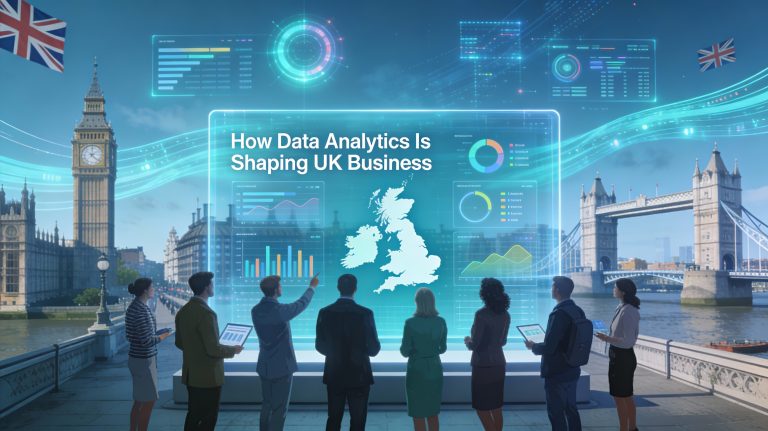
Across the UK, data analytics has shifted from back-office reporting to a strategic capability that determines which businesses grow, adapt, and outperform competitors. The UK data analytics market was valued at roughly USD 3.5–4.7 billion in 2024 and is expected to grow to around USD 17–25 billion by 2030–2033, reflecting rapid adoption across industries. This blog explores how data analytics is transforming key UK sectors, the benefits for organisations of all sizes, and where the next wave of innovation is heading.
How to Build Demand Forecasting Software
Why Data Analytics Matters to UK Businesses
UK companies increasingly see data as a core asset that underpins competitiveness, resilience, and innovation.
-
Around three-quarters of UK businesses now prioritise data to drive performance, highlighting a shift from intuition-led to insight-led decisions.
-
Analytics helps organisations anticipate market shifts, simulate scenarios, and respond faster to changing customer needs and economic pressures.
-
For SMEs, data analytics supports improved decision making, better understanding of customers, and more efficient operations, narrowing the gap with larger competitors.
Key benefits frequently cited by UK businesses include:
-
Faster, evidence-based decisions instead of guesswork.
-
Reduced costs through process optimisation and elimination of bottlenecks.
-
Stronger customer relationships through targeted, personalised engagement.
Sector-by-Sector Impact Across the UK
Data analytics is shaping the future differently in each sector, but with a common thread: more precise, proactive decision-making.
-
Retail and eCommerce
-
UK retailers use predictive analytics to personalise offers, optimise pricing, and forecast demand, improving conversion and margins.
-
Analytics also supports inventory optimisation and omnichannel experiences, reducing stockouts and enhancing customer satisfaction.
-
-
Financial services
-
Finance and insurance are among the top sectors for advanced analytics and AI adoption in the UK, with adoption rates above 60% in some surveys.
-
Banks and fintechs use analytics for fraud detection, credit scoring, risk modelling, and personalised financial products.
-
-
Healthcare and life sciences
-
Providers use analytics to improve diagnostic accuracy, optimise treatment pathways, and allocate resources more efficiently.
-
Population-level data supports better planning, while predictive models help identify at-risk patients earlier.
-
-
Manufacturing, logistics, and energy
-
Manufacturers and logistics firms deploy data analytics for predictive maintenance, supply chain optimisation, and demand planning.
-
In energy, analytics supports load forecasting, grid optimisation, and integration of renewables, boosting reliability and sustainability.
-
-
Public sector and local government
-
UK public bodies increasingly use analytics for service planning, resource allocation, and measuring policy impact.
-
Data-driven insights help improve citizen services and identify where interventions deliver the greatest value.
-
How Data Analytics Empowers UK SMEs
For UK SMEs, data analytics has become a practical way to compete with larger players by using insight rather than scale.
-
Operational efficiency
-
SMEs analysing operational data can identify inefficiencies, reduce waste, and improve productivity, directly impacting profitability.
-
Tools like dashboards and business intelligence platforms make it easier to monitor KPIs in real time.
-
-
Targeted marketing and customer insight
-
Analytics enables small firms to segment customers, tailor messaging, and focus spend on high-value segments, improving ROI.
-
Behaviour and purchase data help SMEs refine offerings and build long-term customer loyalty.
-
-
Competitive advantage and innovation
-
UK SMEs using analytics gain better visibility into market trends and competitor activity, helping them spot opportunities earlier.
-
Even simple analytics (sales trends, channel performance, campaign analysis) can drive more confident, growth-oriented decisions.
-
Future Trends: Where Data Analytics Is Taking UK Business
Emerging trends in analytics are set to deepen its impact across UK sectors in the coming years.
-
AI and machine learning embedded everywhere
-
AI-driven analytics, including predictive and prescriptive models, is moving from specialised teams into everyday business processes.
-
This shift enables automated decision support, from dynamic pricing to smart routing and personalised recommendations.
-
-
Augmented analytics and self-service BI
-
Augmented analytics tools help non-technical staff interact with data using natural language queries and guided insights.
-
This broadens analytics adoption beyond data teams, making insight generation a normal part of daily work.
-
-
Higher adoption, but also new challenges
-
UK surveys show high adoption of advanced digital technologies like AI, big data, and cloud, but also highlight gaps in skills and technology diffusion, especially for smaller firms.
-
Data privacy, governance, and talent shortages remain key challenges, pushing organisations to invest in training and robust data strategies.
-
Conclusion
Data analytics is reshaping the future of UK businesses by turning raw data into a strategic resource that drives growth, resilience, and innovation across sectors. From retail personalisation and financial risk management to SME efficiency and public-sector optimisation, analytics is now embedded in how organisations plan, decide, and compete. To stay ahead, UK businesses should invest in clear data strategies, accessible analytics tools, and upskilling teams so insight becomes a daily habit rather than an occasional project.
A strong call-to-action: Audit how your organisation currently uses data, identify two or three high-impact decisions that could be improved with analytics, and pilot a focused data project that delivers measurable value within 90 days.
FAQ
1. Which UK sectors are leading in data analytics adoption?
Finance and insurance, retail, healthcare, manufacturing, energy, and parts of the public sector are among the leading adopters of data analytics in the UK.
2. How does data analytics help UK SMEs?
It helps SMEs make better decisions, improve operational efficiency, understand customers more deeply, and gain competitive advantage despite limited resources.
3. What are the main challenges with data analytics in the UK?
Common challenges include data quality, privacy and compliance, skills shortages, and difficulty integrating analytics into day-to-day decision-making.
4. Is data analytics only for large enterprises?
No. Affordable cloud tools, self-service dashboards, and packaged BI solutions now make analytics accessible to even very small UK firms.
5. What future trends should UK businesses watch?
Key trends include deeper integration of AI and machine learning, growth of augmented analytics, and broader sector-wide adoption supported by cloud and data infrastructure investments.