Introduction
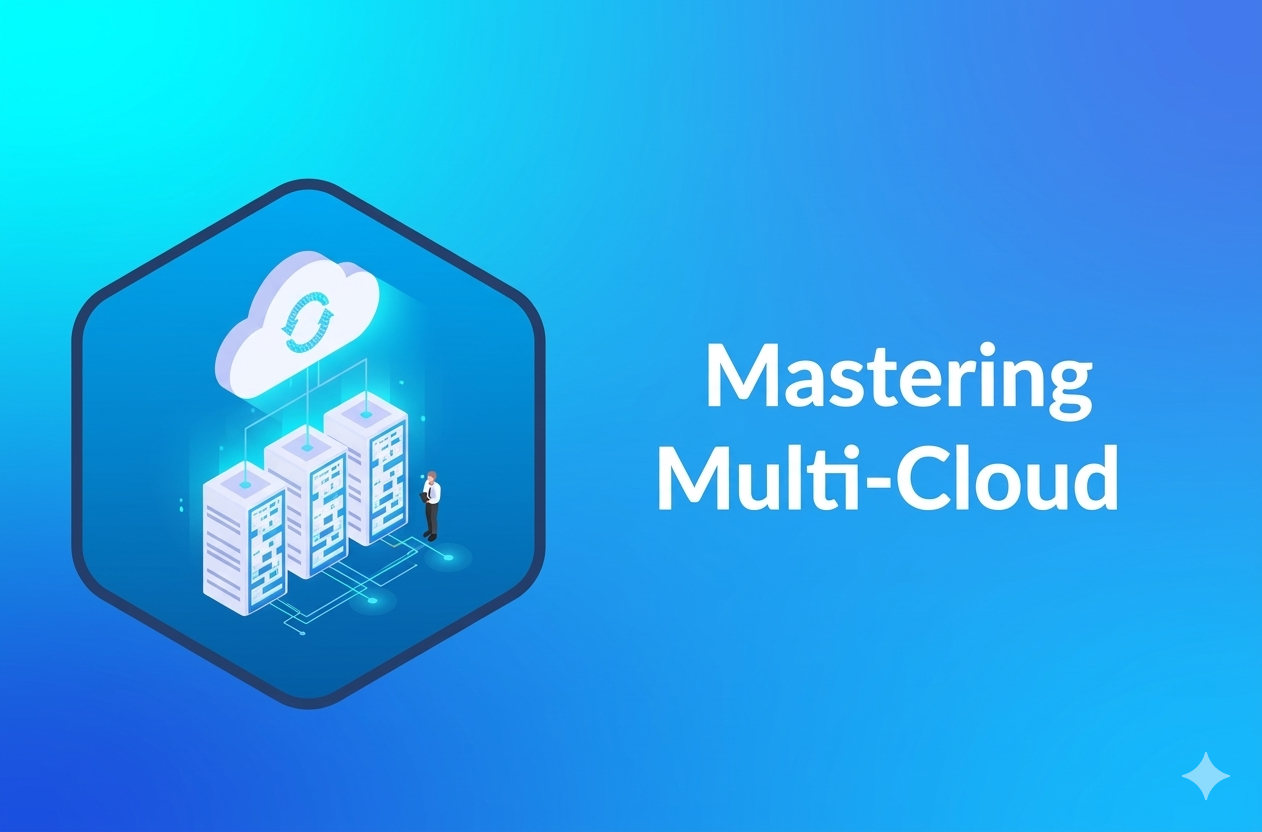
Multi-cloud mastery means running workloads across AWS, Azure, and GCP simultaneously—balancing each provider’s strengths without chaos. In 2026, enterprises use multi-cloud for cost optimization (pick cheapest region), resilience (no single outage), and best-of-breed services (Azure AI + AWS storage). The challenge lies in unified management, security, and governance across fragmented platforms.
Success requires standardized identity, networking, and observability layers. Without them, multi-cloud becomes expensive complexity.
In 2026, multi-cloud strategies have become the default for 87% of enterprises, up from just 76% two years prior, driven by the need to avoid vendor lock-in while leveraging each cloud provider’s unique strengths. AWS dominates compute and storage, Azure leads in AI/ML services through OpenAI integration, and GCP excels in data analytics with BigQuery—all working together in production environments rather than competing.
Multi-cloud mastery isn’t about running everything everywhere. It’s a deliberate architecture that routes workloads to the optimal provider based on cost, performance, compliance, or regional availability. A financial services firm might process AI fraud detection on Azure’s GPU clusters, store petabytes in AWS S3 Glacier Deep Archive, and run analytics queries on GCP’s BigQuery—all synchronized through a single control plane.
This approach delivers three core benefits:
-
Resilience: When AWS US-East-1 goes down (as it did in December 2025), Azure and GCP workloads continue unaffected.
-
Cost optimization: Dynamic workload placement saves 10-30% by always choosing the cheapest region or service equivalent.
-
Innovation velocity: Teams pick best-of-breed services without re-architecting for a single vendor.
However, without proper tooling and patterns, multi-cloud becomes expensive chaos—fragmented security policies, inconsistent monitoring, and runaway costs. This guide delivers the architectures, tools, and practices that make multi-cloud work at scale.
Why Multi-Cloud Dominates 2026
Enterprises adopt multi-cloud for strategic reasons beyond basic redundancy:
-
Vendor independence: No single provider dictates your architecture or pricing.
-
Regional compliance: EU GDPR data stays in Frankfurt (AWS/GCP), US healthcare data in US-only regions.
-
Workload optimization: AI inference on Azure A100s, bulk storage on AWS S3 Intelligent-Tiering, analytics on GCP BigQuery.
-
Disaster recovery: Active-active setups across clouds eliminate single points of failure.
Key stat: Multi-cloud adopters report 25% lower infrastructure costs and 40% higher uptime compared to single-cloud peers.
Core Multi-Cloud Architectures
Workload Distribution Architecture
Why Multi-Cloud Dominates 2026
Enterprises adopt multi-cloud for deliberate reasons:
-
Avoid vendor lock-in: Switch providers without re-architecting apps.
-
Cost optimization: Run AI workloads on cheapest GPUs, storage in low-cost regions.
-
Resilience: One provider down? Failover to another seamlessly.
-
Compliance: Store regulated data in specific regions (EU data in Frankfurt).
-
Best-of-breed: Azure OpenAI + GCP BigQuery + AWS S3.
Adoption stat: 87% of enterprises run multi-cloud, up from 76% in 2024.
Core Multi-Cloud Architectures
1. Workload Distribution Model
Route workloads by capability:
-
Compute-heavy: AWS Graviton/EC2 (cost), GCP Tau VMs (performance).
-
AI/ML: Azure for OpenAI, AWS SageMaker, GCP Vertex.
-
Data lakes: Snowflake across all, or AWS S3 + BigQuery federation.
-
Edge/IoT: Azure IoT Hub + AWS IoT Greengrass.
Key: Clear placement rules prevent sprawl.
2. Service Mesh Architecture
Use Istio or Linkerd across Kubernetes clusters:
-
Cross-cloud traffic: Secure service-to-service communication.
-
Observability: Unified metrics, traces, logs via OpenTelemetry.
-
Resilience: Circuit breakers, retries, timeouts work everywhere.
Example: EKS (AWS) + AKS (Azure) + GKE (GCP) with shared Istio control plane.
3. Centralized Control Plane
One platform governs all clouds:
-
GitOps: ArgoCD or Flux deploys same manifests everywhere.
-
Policy-as-code: Open Policy Agent (OPA) enforces security/compliance.
-
Infrastructure-as-code: Terraform with state backends per cloud.
Implementation Best Practices
-
Unified Identity: Okta or Azure AD B2C federates across clouds.
-
Networking: Use Aviatrix or Megaport for secure cross-cloud VPN.
-
Monitoring: Prometheus + Grafana stack with Thanos for multi-cluster.
-
FinOps: Automated rightsizing, reserved instance management.
-
Security: OPA/Gatekeeper policies + Falco for runtime security.
Migration path:
-
Inventory existing workloads.
-
Define placement rules (cost/performance/compliance).
-
Deploy control plane (Istio + ArgoCD).
-
Migrate non-critical workloads first.
Real-world example: floLIVE uses multi-cloud for IoT—lower latency via regional breakouts, compliance via data sovereignty.
Conclusion
Multi-cloud mastery in 2026 demands architectural discipline: unified identity, GitOps, service mesh, and FinOps. Tools like CloudHealth, Morpheus, and Anthos make it manageable. Start small—pick two clouds, one workload type, and scale with proven patterns. The result: resilience, cost savings, and innovation without lock-in.
Ready to unify your clouds? Deploy CloudHealth today for instant visibility.
FAQ
What is multi-cloud vs. hybrid cloud?
Multi-cloud uses multiple public clouds (AWS+Azure). Hybrid combines public + private/on-prem.
Which tool for multi-cloud beginners?
CloudHealth—immediate cost visibility across AWS/Azure/GCP.
How to avoid multi-cloud complexity?
Standardize on Kubernetes + Istio + GitOps. One platform, many clouds.
Does multi-cloud save money?
Yes—10-30% via workload placement on cheapest regions/services.
-