




TechOTD

Transform Your Business with AI — TechOTD

Unlock faster, scalable outcomes with TechOTD’s cutting-edge AI. Advanced models automate workflows, deliver valuable predictive insights, accelerate innovation, empowering organizations to optimize operations, elevate customer experiences, and drive sustainable growth.

AI Services

Explore AI services offered to transform your business with innovative solutions, leveraging cutting-edge machine learning, automation, and predictive analytics. Our AI-driven tools enhance efficiency, reduce costs, and unlock new growth opportunities. From personalized customer experiences to intelligent process optimization, we deliver scalable AI solutions tailored to your needs. See how these capabilities apply in a regulated field with our AI solutions for legal teams.

Machine Learning

Leverage algorithms that learn from data to provide predictive insights and automation.

Classification icon

Classification

Regression icon

Regression

Tech Stack

Explore the technologies and tools that power our AI solutions, including cutting-edge machine learning frameworks, cloud computing platforms, and advanced data processing systems. Our AI leverages natural language processing (NLP) and computer vision to deliver intelligent, real-time insights.

Python icon

Python

Big Data icon

Big Data

Machine Learning icon

Machine Learning

ETL icon

ETL

Databricks icon

Databricks

OpenCV icon

OpenCV

Scikit-learn icon

Scikit-learn

Pandas icon

Pandas

Tableau icon

Tableau

TensorFlow icon

TensorFlow

Grafana icon

Grafana

Azure icon

Azure

AWS icon

AWS

API icon

API

DevOps icon

DevOps

Oracle icon

Oracle

Jupyter icon

Jupyter

Kubernetes icon

Kubernetes

AI Solution Development Roadmap We Offer

Implementing AI in business requires a structured approach to ensure seamless integration, reliability, and measurable outcomes. Keeping this in mind, we, as a leading artificial intelligence solutions company, follow a structured process that focuses on leveraging AI to unlock new business opportunities while maintaining security and compliance.

Analyze Business NeedsFirst, we assess your business needs and existing tech ecosystem to determine if AI-driven solutions are the right investment and how they will add value to your operational growth.

Evaluate Data SourcesNext, we explore and evaluate data sources, including corporate assets and public databases. This step ensures we have relevant and high-quality data for AI model development.

Design the ProductWe, as a premium artificial intelligence services company, choose the best tech stack, craft the product's architecture, and outline an implementation plan. We also offer a PoC to validate feasibility and viability.

Develop AI SolutionEventually, our AI developers conduct data preprocessing, model training, and ensemble modeling processes to ensure optimal AI performance.

Deploy AI ModelHere comes the most vital step of the process. We integrate the trained AI software solutions into the existing architecture or the cloud at this stage.

Ongoing SupportAs an elite AI service provider, we also provide post-launch support, data retraining, and ongoing maintenance to ensure uninterrupted AI performance and continuous model refinement.

Client Testimonials

Hear what our clients have to say about our AI solutions.

TechOTD's AI solutions revolutionized our data analysis, providing insights we never thought possible. Their team was professional and delivered beyond our expectations.

— Genesis, Afria Market

The machine learning models developed by TechOTD have significantly improved our operational efficiency. We've seen a remarkable ROI in a short period.

— Raj Keshwarwani, Koishu Digital

Working with TechOTD on our computer vision project was a seamless experience. Their expertise in AI is top-notch, and they are a reliable technology partner.

— Sameer Leekha, Business Technology Junction

Latest AI Blogs

Stay updated with the latest trends and insights in Artificial Intelligence.

AI search optimization for websites and modern search visibility

How to Get Your Website Recommended by AI Search in 2026

Artificial intelligence is changing the way people discover information online. Instead of only showing a traditional list of search results, modern search engines can now generate answers, summarize information, and recommend websites as sources. This change is creating a new opportunity for website owners. Ranking on Google is still important, but businesses also need to understand how their content can become visible in AI-powered search experiences such as AI Overviews and AI Mode. AI search optimization focuses on making website content clear, useful, trustworthy, and easy for search systems to understand. Strong content structure, relevant information, technical SEO, and clear answers can all contribute to better visibility across modern search experiences. In this guide, we’ll explain how AI search works, what makes content easier for AI systems to understand, and the practical steps businesses can take to increase their chances of being discovered and cited in AI-powered search. What Is AI Search Optimization? AI search optimization is the process of improving website content so that AI-powered search systems can understand, interpret, and potentially surface it when answering user queries. It combines traditional SEO principles with clear information structure, useful content, strong context, and trustworthy sources. Traditional SEO mainly focuses on helping search engines understand pages and determine where they should appear in search results. AI search adds another layer because systems may need to understand a question, identify relevant information from multiple sources, and generate a direct response for the user. The goal is not to create content specifically for an AI system at the expense of users. Instead, websites should provide accurate, original, well-structured information that clearly answers real questions. This can make content easier for both traditional search engines and AI-powered search experiences to understand. How AI Search Is Different From Traditional Search Traditional search and AI-powered search can use many of the same underlying signals, but the user experience is different. Instead of only returning a list of links, AI search can combine information and provide a conversational answer with supporting sources. Traditional Search In traditional search, a user enters a query and receives a ranked list of web pages. SEO helps search engines understand the content, relevance, and structure of those pages so they can be matched with appropriate queries. AI-Powered Search AI-powered search can interpret more complex questions, identify relevant information, and generate a response using information from multiple sources. Depending on the search experience, users may also see links or citations to websites that support the answer. Why This Matters for Websites A website may therefore need to do more than target individual keywords. Its content should clearly explain topics, answer related questions, provide useful context, and demonstrate credibility. Well-organized information can make it easier for search systems to understand what a page is about and when it may be relevant. How AI Search Chooses Information AI-powered search does not simply look for a page containing an exact keyword. It needs to understand the meaning of a query and identify information that is relevant, useful, and trustworthy. This makes the quality and structure of website content increasingly important.   Relevance to the User’s Question Content should directly address the question a user is asking. A page that clearly explains a topic and answers related questions can provide more useful information than a page that simply repeats a keyword many times. Clear and Structured Information Clear headings, short sections, descriptive titles, lists, tables, and well-organized paragraphs help users understand information quickly. They also provide useful context about the purpose and subject of different sections of a page. Original and Helpful Content Websites should provide information that adds genuine value instead of simply rewriting information already available elsewhere. Original examples, practical explanations, firsthand experience, useful data, and unique insights can make a page more valuable to readers. Trust and Credibility Important claims should be supported by reliable sources where appropriate. Clear authorship, accurate information, transparent references, and a trustworthy website experience can help establish credibility. Fresh and Updated Information Some topics change quickly, especially technology, software, security, and business. Keeping information accurate and updating outdated sections can make content more useful when people search for current information. 7 Practical Ways to Optimize Your Website for AI Search Getting visibility in AI-powered search is not about adding a special meta tag or using one secret SEO technique. It starts with creating content that is genuinely useful, technically accessible, easy to understand, and supported by clear information. 1. Create Direct Answers to Real Questions Research the questions your target audience actually asks and create dedicated sections that answer those questions clearly. Avoid unnecessary introductions before giving the main answer. A direct and complete explanation makes the content more useful for both readers and search systems. 2. Build Topic Depth Instead of Keyword Stuffing Cover the important aspects of a topic rather than repeatedly inserting the same keyword. Related concepts, examples, definitions, comparisons, and practical information help establish the context of a page without making the content unnatural. 3. Use Clear Content Structure Organize articles with descriptive headings, short paragraphs, lists, tables, and clearly separated sections. A logical structure helps visitors find information quickly and makes the relationship between different parts of the topic easier to understand. 4. Add Firsthand Experience and Original Insights Whenever possible, include original examples, experiments, case studies, screenshots, data, or lessons learned from real projects. Unique information gives users a reason to visit your website instead of relying only on content that repeats what other websites have already published. 5. Support Important Claims With Reliable Sources When an article includes statistics, research findings, technical claims, or current information, link to reliable sources that support those claims. This gives readers a way to verify important information and adds useful context to the article. 6. Strengthen Internal Linking Connect related pages across your website using natural and descriptive anchor text. Internal links help visitors discover related information and help search systems understand how different pages within your website are connected. 7. Keep Technical SEO Strong

AI scams in 2026 using deepfakes, voice cloning, phishing, and fake identities

AI Scams in 2026: How Technology Is Making Scams Harder to Detect

Artificial intelligence is changing the way we work, communicate, and do business. But the same technology is also giving scammers powerful new ways to deceive people. From AI-generated phishing messages and cloned voices to deepfake videos and highly personalized fraud, scams are becoming harder to recognize than ever. In 2026, AI scams are no longer limited to obvious fake messages. Attackers can use AI to imitate trusted people, create convincing websites, generate realistic audio and video, and personalize scams at scale. This makes traditional warning signs less reliable and increases the need for smarter prevention. The good news is that AI can also be used to fight back. AI-powered fraud detection, behavioral analysis, deepfake detection, and real-time scam monitoring can help individuals and businesses identify suspicious activity before it causes serious damage. In this article, we’ll explore how AI-powered scams work, why they are becoming harder to detect, and how technology and practical security habits can help prevent them. What Are AI-Powered Scams? AI-powered scams are fraudulent activities that use artificial intelligence to make scams more convincing, personalized, or difficult to detect. Instead of relying only on traditional scripts and fake messages, scammers can now use AI to generate realistic text, images, audio, video, and even fake identities. For example, a scammer can use AI to create a convincing phishing email that looks like it came from a bank, generate a voice that sounds like a family member, or create a deepfake video of a trusted person. These technologies allow criminals to make their attacks appear much more legitimate. The biggest change is the scale and speed of these attacks. AI allows scammers to create personalized content for thousands of targets with far less effort than before. This makes AI-powered fraud a growing challenge for individuals, businesses, financial institutions, and online platforms. How Scammers Are Using AI 1. AI-Generated Phishing Messages AI can generate highly convincing phishing emails, text messages, and social media messages within seconds. Scammers can customize these messages using information about a person’s job, interests, recent activities, or relationships, making fraudulent communication appear more legitimate. 2. Voice Cloning and Impersonation Voice cloning technology can reproduce a person’s voice from a relatively short audio sample. Scammers can use cloned voices to impersonate family members, company executives, customer support agents, or other trusted individuals and create urgent requests for money or sensitive information. 3. Deepfake Videos and Images AI-generated images and deepfake videos can make it appear as though a real person said or did something they never actually did. Scammers may use this technology to impersonate public figures, business leaders, or people known to the victim. 4. Fake Websites and AI-Generated Content Generative AI can help scammers create professional-looking websites, advertisements, product descriptions, and fake customer support conversations. When combined with stolen logos and copied branding, these websites can be difficult to distinguish from legitimate services. 5. Personalized Scams at Scale One of AI’s biggest advantages for scammers is automation. Instead of sending the same message to everyone, criminals can generate different messages for different targets. This makes scams more personalized while allowing attackers to reach a much larger number of people. Most Common AI Scams in 2026 AI-powered scams can take many forms, depending on the technology being used and the information available to the attacker. Some scams target individuals directly, while others are designed to manipulate employees, customers, or entire organizations. AI Voice Scams Scammers can use AI voice cloning to imitate someone the victim knows or trusts. A fake emergency call from a family member or an urgent payment request from a senior executive can create pressure to act without verification. Deepfake Investment Scams Deepfake videos and AI-generated content can be used to make fake investment opportunities appear credible. Scammers may impersonate business leaders, financial experts, or public figures to encourage victims to send money or share financial information. AI-Powered Phishing Scams AI makes it easier for scammers to create phishing messages that look professional and contain fewer obvious spelling or grammar mistakes. These messages may imitate banks, delivery companies, employers, government services, or popular online platforms. Fake Customer Support Scams Scammers can use AI-generated websites, chatbots, and social media profiles to imitate legitimate customer support services. Victims may be tricked into revealing passwords, verification codes, payment details, or other sensitive information. Romance and Social Engineering Scams AI can help scammers maintain convincing conversations for longer periods and personalize their communication based on information gathered from social media. This can make fake relationships, investment requests, or emotional manipulation much more difficult to recognize. Why AI Scams Are Harder to Detect Traditional scams often contain obvious warning signs such as poor grammar, generic messages, suspicious links, or unrealistic offers. AI can remove many of these clues by generating polished, natural-sounding, and highly targeted content. AI also makes impersonation more convincing. A cloned voice can sound like someone the victim knows, while a deepfake video can create the appearance of a real person speaking or appearing on camera. When a scam uses familiar identities and realistic communication, people may be more likely to trust it. Another challenge is speed. Scammers can use AI to create and modify fraudulent content quickly, test different approaches, and target large numbers of people. As AI-generated content becomes more realistic, relying only on visual or grammatical clues is no longer enough to identify every scam. How AI Can Help Prevent Scams While criminals are using AI to make scams more convincing, the same technology can also help detect and prevent fraud. AI systems can analyze large amounts of data, identify unusual patterns, and detect suspicious behavior much faster than traditional rule-based systems. Real-Time Scam Detection AI-powered security systems can analyze messages, websites, emails, and online interactions in real time. By identifying suspicious patterns and known indicators of fraud, these systems can warn users before they click a malicious link or share sensitive information. Behavioral Fraud Detection AI can learn normal user behavior and identify unusual activity. For example, an unexpected login, unusual transaction,

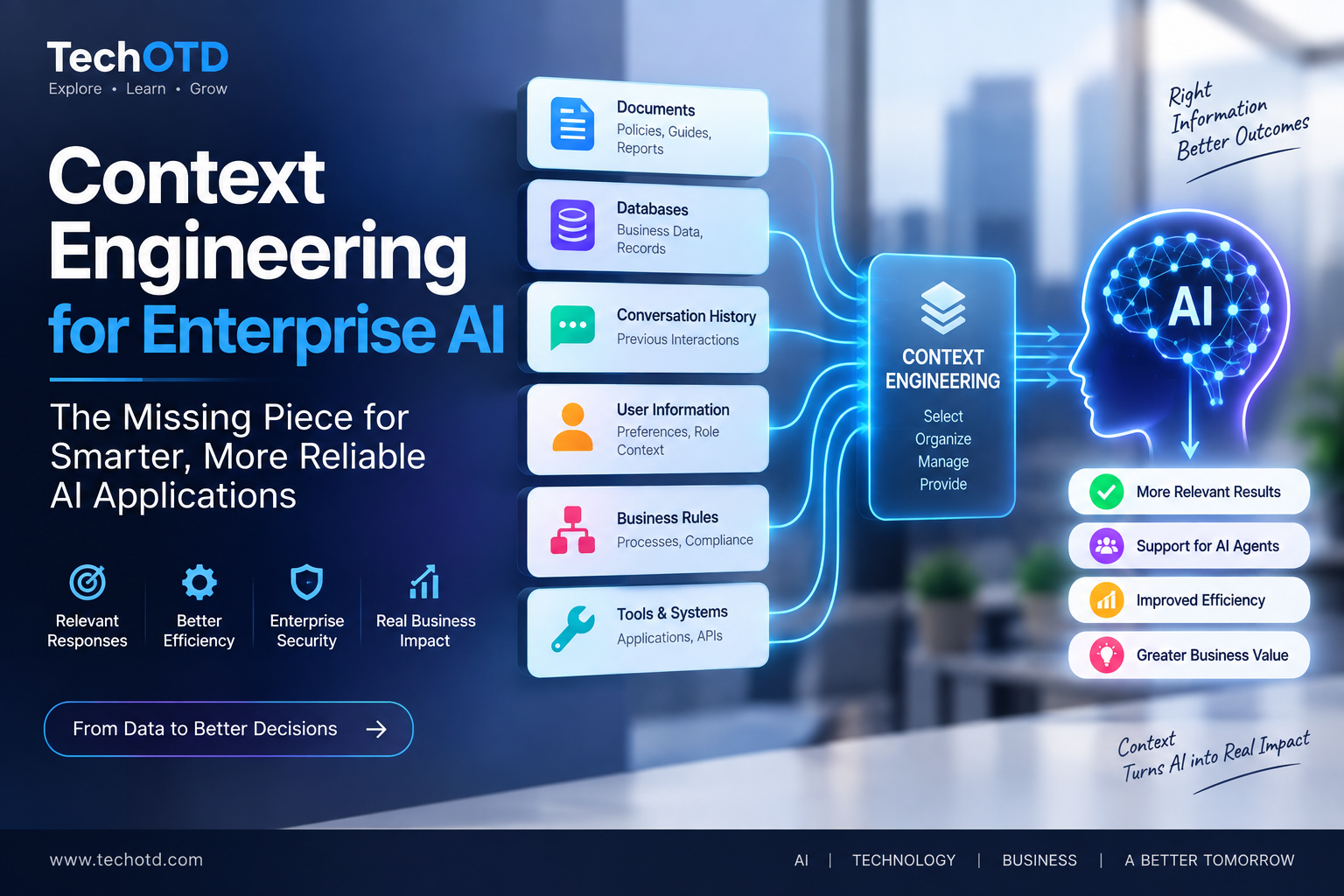
Context engineering for enterprise AI using business data and relevant information

Context Engineering: Why It Is Becoming Essential for Enterprise AI

Introduction As artificial intelligence becomes more deeply integrated into business applications, the quality of AI responses depends on more than the prompt alone. AI systems often need access to relevant information, instructions, user history, business data, and task-specific context to produce useful and reliable results. Prompt engineering focuses on designing effective instructions for AI models, but enterprise AI applications often require a broader approach. Businesses need to determine what information should be provided to an AI system, how that information should be structured, and when it should be included in the AI workflow. Context engineering is the process of designing and managing the information available to an AI system so it can better understand a task and generate more relevant responses. As organizations build AI agents and complex AI applications, effective context management is becoming increasingly important for performance, reliability, and scalability. What Is Context Engineering? Context engineering is the process of selecting, organizing, and providing the right information to an AI system so it can better understand a task and generate relevant, accurate, and useful responses. This information can include instructions, user preferences, conversation history, business data, documents, retrieved knowledge, and details about the current task. More Than Writing Better Prompts Prompt engineering focuses primarily on how instructions are written, while context engineering takes a broader approach. It considers everything the AI system needs to know before generating a response, including relevant background information, data, rules, and the current situation. Providing the Right Information at the Right Time An AI system does not always need access to every available piece of information. Context engineering helps determine which information is relevant to a specific task and when that information should be provided to the model. Managing Different Types of Context Enterprise AI applications may use multiple types of context, including system instructions, conversation history, customer information, company documents, database records, retrieved knowledge, and outputs from other AI tools or workflows. Why Context Quality Matters The quality and relevance of the information provided to an AI model can directly influence the usefulness of its output. Too little context may lead to incomplete responses, while irrelevant or excessive information can make it harder for the AI system to focus on the task. By carefully managing what information an AI system receives, businesses can build applications that produce more relevant and consistent results while using AI resources more efficiently. Context Engineering vs Prompt Engineering Context engineering and prompt engineering are closely related, but they focus on different parts of an AI interaction. Prompt engineering focuses on designing effective instructions, while context engineering focuses on managing the broader set of information that an AI system receives before generating a response. The Role of Prompt Engineering Prompt engineering focuses on how instructions are written and structured to guide an AI model toward a desired response. A well-designed prompt can clarify the task, define the expected output, and provide instructions about tone, format, or constraints. The Role of Context Engineering Context engineering considers the wider information environment around the prompt. This can include conversation history, user preferences, business rules, retrieved documents, database information, previous actions, and other task-specific data. Why Enterprise AI Needs Both Enterprise AI applications often require both effective prompts and well-managed context. Clear instructions help the AI understand what it should do, while relevant context helps the model understand the information and situation required to complete the task effectively. A Simple Example A customer support AI may receive an instruction to answer a customer’s question, but it may also need access to the customer’s recent interactions, product information, account details, company policies, and relevant support documents. Context engineering helps determine which of this information should be available for that specific request. Prompt engineering helps define the task, while context engineering helps provide the information needed to complete that task. Together, they can support more useful and reliable AI applications. Why Context Engineering Is Important for Enterprise AI Enterprise AI applications often operate in complex environments where a simple prompt is not enough to produce reliable results. AI systems may need access to business knowledge, user information, current data, previous interactions, and specific organizational rules to understand and complete a task effectively. Enterprise Information Is Often Distributed Business information may be stored across documents, databases, internal applications, knowledge bases, and communication systems. Context engineering helps determine how relevant information can be selected and provided to AI applications when it is needed. Better Context Can Improve AI Output Quality AI models can generate more useful responses when they receive relevant and accurate information about the task. Providing appropriate context can help reduce incomplete responses and improve the relevance of AI-generated outputs. Supporting AI Agents and Complex Workflows AI agents often perform tasks across multiple steps and may interact with different tools, systems, and sources of information. Context engineering can help ensure that an AI agent has access to the relevant information required at each stage of a workflow. Reducing Unnecessary Information Providing every available document or data source to an AI model can create unnecessary complexity and increase resource usage. Context engineering helps focus the AI system on information that is relevant to the current task. Supporting More Consistent AI Applications Enterprise AI applications may be used by many employees, customers, or automated systems. Well-managed context can help create more consistent behavior by ensuring that AI systems receive relevant instructions and information across different interactions. As enterprise AI systems become more connected to business data and workflows, context engineering can play an important role in improving AI performance, reliability, efficiency, and scalability. Key Components of Context Engineering Effective context engineering involves managing different types of information that can influence how an AI system understands and completes a task. Businesses need to decide what information should be included, how it should be organized, and when it should be provided to the AI model. System Instructions System instructions define the overall role, rules, priorities, and behavior expected from an AI system. They can provide consistent guidance

Our Technology Experts Are Change Catalysts

Book A Free Consultation Call With Our Experts Today

Frequently Asked Questions

Find answers to the most common questions about our AI services